
This browser is no longer supported.
Please use a more recent browser to use this website.


 MENU
Anyone designing a laser around tissue ablation eventually runs into the same governing variable: water absorption in the mid-IR. Because human tissue is rich in water, this parameter sets the optical penetration depth, which sets the ablation threshold, which sets how tightly the thermal damage zone can be confined. Wavelength selection in this part of the spectrum is not a stylistic choice; it is a direct lever on the physics of the process.
2910 nm sits inside water’s strongest mid-IR absorption feature, close enough to the maximum that its optical behavior is, for most engineering purposes, indistinguishable from the peak itself.
Water’s mid-IR absorption in this region originates from the O-H stretching vibration, producing a broad, strong band centered close to 2.94 µm. The dataset most laser-tissue work still cites is Hale and Querry’s 1973 measurement of water’s optical constants across 200 nm to 200 µm (Hale & Querry, 1973), corroborated by others, including Robertson and Williams’ independent infrared measurements (Robertson & Williams, 1971).
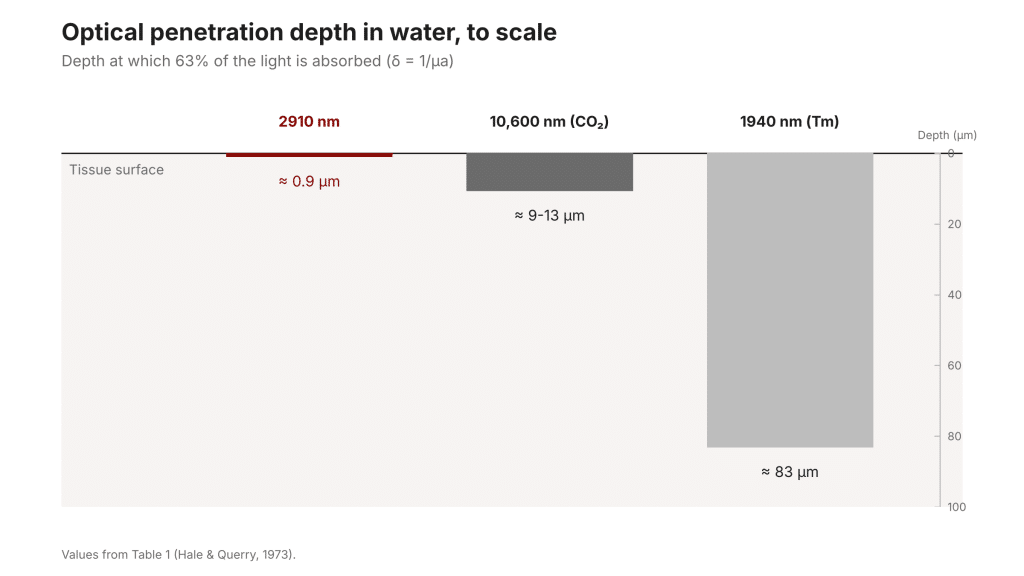
At 2900 nm, Hale and Querry report an absorption coefficient of roughly 11,600 cm⁻¹; at 2950 nm, roughly 12,700 cm⁻¹. 2910 nm falls inside that bracket, meaning its absorption coefficient is within about 5-10% of the maximum rather than at some meaningfully lower point on the curve. Converted to optical penetration depth (1/µa), that is roughly 0.8-0.9 µm across the full 2900-2950 nm span, essentially flat by the standards of anything downstream that depends on it.
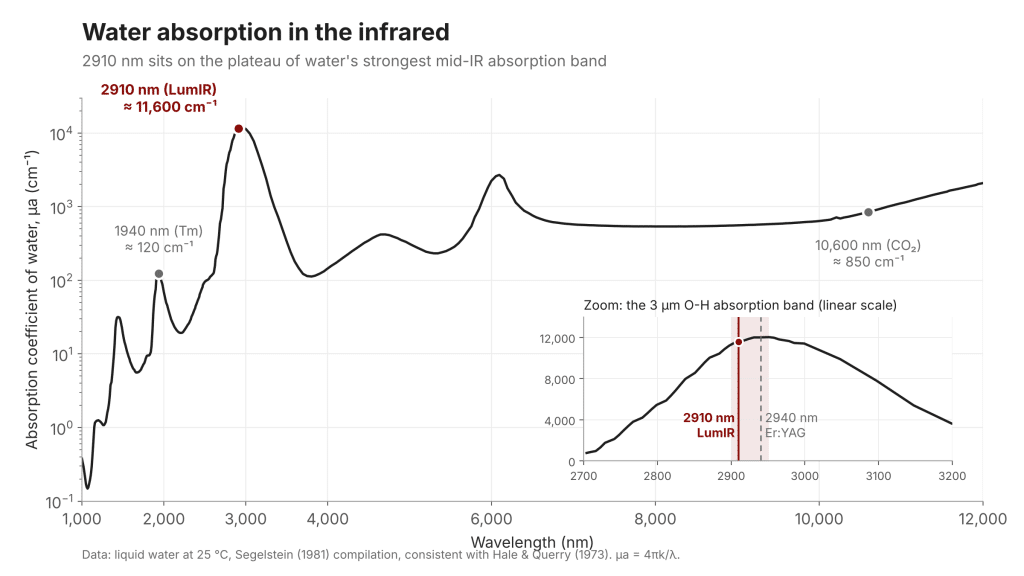
While the absorption maximum sits closer to 2940-2950 nm, matching the Er:YAG wavelength, what matters more for design purposes than the location of the maximum itself is that the curve is broad enough that 2910 nm remains in the high-absorption regime.
| Wavelength | Absorption coefficient (water) | Optical penetration depth |
| 2900 nm | ~11,600 cm⁻¹ | ~0.86 µm |
| 2950 nm (near peak) | ~12,700 cm⁻¹ | ~0.79 µm |
| 1940 nm (Tm-band) | ~120 cm⁻¹ | ~83 µm |
| 10,600 nm (CO2) | ~790-1,110 cm⁻¹* | ~9-13 µm |
Table 1. Absorption coefficients and optical penetration depths at common treatment laser wavelengths. Source: Hale and Querry, 1973 (see References). *Range reflects measured values at 10,500 and 11,000 nm bracketing the CO2 line. Source: Hale & Querry, 1973.
A sub-micron penetration depth means nearly all absorbed energy is deposited in a layer thinner than most cellular or microstructural features of interest. Two consequences follow directly. The ablation threshold fluence drops, since energy is not distributed over a larger absorbing volume versus at non-peak wavelengths, and thermal confinement improves, since the heated volume is small relative to the rate of thermal diffusion out of it.
But optical penetration depth alone does not determine the realized heat-affected zone (HAZ); pulse duration relative to the thermal relaxation time of the absorbing volume does. Anderson and Parrish’s thermal relaxation time framework (Anderson & Parrish, 1983) gives the order-of-magnitude scaling: τr~ d²/(4κ), where d is the absorbing depth, and κ is thermal diffusivity. For water, κ ≈ 1.4 × 10⁻³ cm²/s, and with d ≈ 0.8-1 µm, τr works out to roughly 1-2 µs.
This is where the empirical data is helpful. Walsh, Flotte, and Deutsch measured HAZ directly for 2.94 µm Er:YAG ablation of skin, cornea, aorta, and bone (Walsh, Flotte & Deutsch, 1989). Normal-spiking-mode pulses (~200 µs, two orders of magnitude longer than τr) left 10-50 µm of residual thermal damage; Q-switched pulses (~90 ns, well under τr) left only 5-10 µm. The optical penetration depth was effectively identical in both cases; the pulse duration relative to τr was not, and it dominated the outcome.
Anyone designing a source at 2910 nm needs to take into account that wavelength selection to a strong water peak buys a short optical penetration depth and a low ablation threshold, but it does not itself guarantee a minimal HAZ. Pulse duration, and how it sits relative to the thermal relaxation time set by this penetration depth, is the second, independent lever.
One nuance that matters more at 2910-2940 nm than almost anywhere else in the spectrum is that water’s absorption coefficient is temperature-dependent, and the temperature dependence is unusually strong in this band. Vogel and Venugopalan’s review notes that the absorption coefficient near 3 µm can drop by roughly a factor of two as water approaches boiling (Vogel & Venugopalan, 2003), a bleaching effect driven by the disruption of hydrogen bonding that underlies the O-H resonance.
Practically, this means the simple Beer-Lambert picture, a fixed µ_a and a fixed penetration depth, is a first-order approximation that holds at the leading edge of a pulse and degrades as the absorbing volume heats. Dynamic absorption changes during the pulse affect coupling efficiency and can shift the effective ablation threshold from what a static-coefficient calculation would predict, an effect documented directly in erbium-laser ablation studies (Cummings & Walsh, 1993). For source and system design, this argues for characterizing ablation performance empirically at the fluences and pulse formats actually intended for use, rather than relying solely on tabulated linear absorption coefficients.
Wavelength sets µ_a and therefore optical penetration depth. However, two other variables need to be carefully considered when building an ablative source in this band. Pulse duration relative to τ_r determines whether that penetration depth translates into a comparably small HAZ or a much larger one. The amount by which the applied fluence exceeds the ablation threshold is not perfectly predicted by a static absorption model at higher pulse energies.
2910 nm gives a system designer a penetration depth practically indistinguishable from the water absorption maximum, while providing higher laser gain than at 2940 nm, resulting in a lower lasing threshold and fewer constraints on the all-fiber laser design and manufacturing. LumIR’s 2910nm fiber laser (link to product) is built around this wavelength as a fiber-delivered, single-mode component for OEM integration; the pulse duration and fluence decisions that translate its penetration depth into target ablation and HAZ remain, as they should, part of the OEM’s system design.
Water absorption in the mid-IR reaches its maximum near 2940 to 2950 nm, and at 2910 nm the absorption coefficient sits within a few percent of that maximum, close enough to deliver the same sub-micron penetration depth and tight thermal confinement relevant to high ablation efficiency. Engineers evaluating a source for OEM integration of ablation-focused laser systems are welcome to contact an expert to discuss the data behind this wavelength in more detail.
Jessie R. Weber PhD, Director, Product and Partnerships