



Strategic Mid-IR Fiber Laser:
Protect. Detect. Neutralize.
Providing mission-critical Mid-IR fiber lasers for advanced defense and sensing. We combine high-power output with superior beam quality to ensure success in DIRCM, remote sensing, and optronic neutralization.

Optronic Requirements in Operational Environments
Modern security and defense systems rely on mastering the electromagnetic spectrum to monitor surroundings, detect remote events, and preserve platform integrity. However, integrators face significant constraints: traditional optical architectures, such as QCLs and OPOs, do not always simultaneously provide useful power, mechanical stability, and beam quality.
Achieving and maintaining a high-power single-mode output with conventional non-fiber sources often requires complex designs that are sensitive to environmental stress. When that single-mode beam quality is lost, it reduces the effective range and the precision of interaction with distant optical targets. Furthermore, these sources require sensitive optical alignments and bulky active cooling systems. These characteristics directly impact SWaP (Size, Weight, and Power) parameters. They complicate onboard integration and can affect operational availability, whereas platform-protection applications demand immediate, reproducible performance.
LumIR 2800 and 3200 Series
The LumIR 2800 and 3200 platforms cover the 2780 to 3300 nm spectral band and were developed for systems requiring a stable and controllable beam. The fiber-based architecture maintains a well-defined propagation over long distances, even under mechanical or thermal stress.

Power up to 10 W (CW / QCW)
Compatible with active protection architectures and Directed Infrared Countermeasures (DIRCM).

Near diffraction-limited Beam Quality (M²<1.3)
Enables precise long-range optical interaction with infrared systems.

All-Fiber Architecture
No critical optical alignment required; high tolerance to vibrations.

Operational readiness
Nominal performance achieved without warm-up cycles, ensuring rapid response in mission-critical situations.

High Spectral Stability
Linewidth <0.15 nm, providing the precision required for high-resolution spectroscopy and molecular sensing.
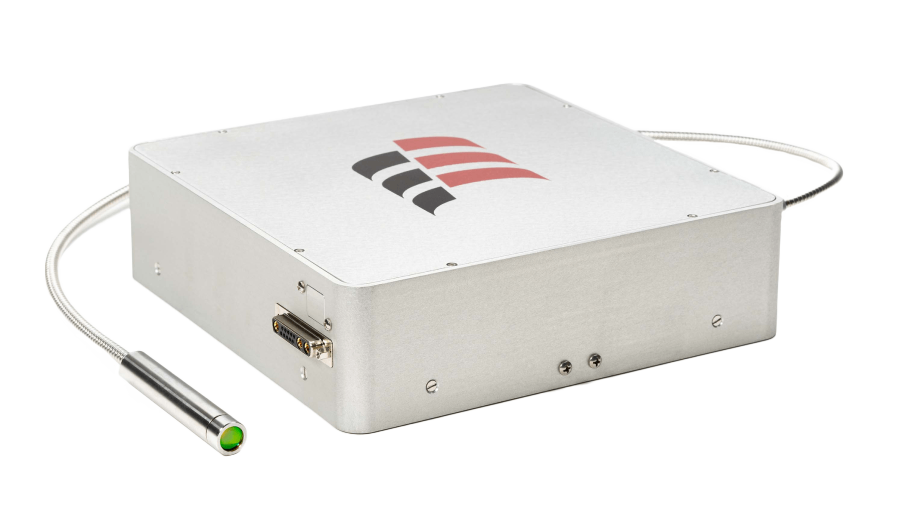
Discover our defense product
LumIR 3200 Series
5 W output power|Available from 3100 to 3300 nm
The 3200 Series delivers a stable 5 W output at 3250 nm, optimized for critical defense applications, including DIRCM and advanced sensing. Its robust all-fiber design ensures seamless integration and can be tailored to any wavelength between 3100 and 3300 nm to match your mission requirements.

Applications

-
Platform Protection (DIRCM / Countermeasures)
Disrupting portable infrared missile seekers (MANPADS) to increase the survivability of aircraft and vehicles. -
Target Designation and Discrete Illumination
High-precision target marking in a MWIR band that is poorly observable by conventional night vision devices. -
Remote Sensing
Remote identification of hydrocarbons, explosives, and CBRN agents via spectral absorption signatures. -
Optronic Sensor Neutralization (Dazzling)
Temporary or permanent reduction of adversarial observation capabilities through optical glaring. -
Active Night Vision Illumination
Provides high-power, discrete illumination to enhance multispectral imaging clarity through smoke, fog, or total darkness at extended ranges.
Architecture and Integration
-
Mechanical Stability
Absence of free-space optics and low sensitivity to vibrations. -
Optimized SWaP
Reduced volume and mass for easier onboard integration. -
Energy Efficiency
Power consumption optimized for battery-powered systems. -
Canadian Manufacturing
Industrial traceability and direct technical support for sensitive programs.

Technical Comparison
| LumIR Fiber Laser (2800/3200) | QCL / ICL Sources | OPO Systems | Er:YAG | |
|---|---|---|---|---|
| Power | ••• | • | •• | ••• |
| System Robustness | ••• | ••• | • | •• |
| Thermal / Power Mgmt | •• | •• | • | • |
| Warm-up Time | ••• | ••• | • | • |
| Beam Quality | ••• | ••• | • | • |
| Ease of Integration | ••• | ••• | • | •• |
| Slide to compare |
Technical Note: QCL/ICL devices require precise electrical and thermal driving to maintain spectral performance. OPOs rely on stable optical alignment. Fiber architectures dissipate heat along the active length and do not require critical optical alignment, simplifying integration and improving stability in mobile environments.
A MWIR source designed for systems and platform protection.
Need a specific wavelength or integration support? Our technical teams can assist in defining your system architecture.